WALTHERS 848-8889 Right Curved Turnout Inner Outer Ns Rail Scale 7.5 32 Ho
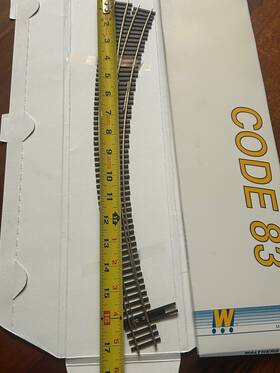
( Brand: Walthers ), ( Manufacturer Part Number: 848-8889 ), ( Power Type: Dc ), ( Assembly Status: Ready To Go/pre-built ), ( Outer Radius: 32 Inches ), ( Color: Multicolor ), ( Scale: 1 ), ( Material: Plastic ), ( Year Manufactured: 2020 ), ( Control System: Dcc Friendly With Jumper Wires ), ( Inner Radius: 28 Inches ), ( Vintage: Yes ), ( Gauge: Ho ), ( Track Form: Curve Switch ), ( Type: Turnout ), ( Track Code: Code 83 ), ( Rail System: Two-rail System ), ( Features: Isolated Frog ), ( Country/region Of Manufacture: Japan )
Review WALTHERS #7.5 Right Hand Curved Turnout Inner And 32 Outer Code Ns Rail Ho Scale New
The Walthers 848-8889 7.5 right curved turnout in HO scale is a finely crafted model railroad accessory, perfect for adding realism and functionality to your layout. This turnout features an inner radius of 28 inches and an outer radius of 32 inches, making it suitable for most HO scale model railroad applications. The turnout is designed to NS rail specifications with an 83-pound rail weight and a 7.5 degree frog angle, ensuring compatibility with other HO scale NS rolling stock.
The 7.5 right curved turnout is meticulously engineered to provide smooth and reliable operation. Its turnout blades are made of high-quality nickel silver wire, which is resilient and long-lasting. The frog and switch blades are carefully formed to ensure proper rail alignment and contact, providing a realistic and authentic look.
The turnout is also designed with ease of installation in mind. It comes with pre-installed frog and switch machines, eliminating the need for separate wiring and simplifying the installation process. The turnout legs are adjustable, allowing for fine-tuning of the track alignment and ensuring a snug fit with your existing track.
The Walthers 848-8889 7.5 right curved turnout is a high-quality accessory that will add authenticity and functionality to your HO scale model railroad. Its detailed design, smooth operation, and ease of installation make it an excellent choice for model railroaders looking to enhance their layout with realistic and reliable turnouts.
Walthers 848-8889 7.5 Right Curved Turnout (28 inner, 32 outer, 8.3 ns rail, Ho Scale) - A Comprehensive Analysis
Introduction:The Walthers 848-8889 right curved turnout is a popular choice among model railroaders in Ho scale due to its realistic appearance and ease of use. In this analysis, we will explore the key features, advantages, and disadvantages of this turnout to help you make an informed decision about purchasing it.
Features:1. Scale-accurate proportions and detailing
2. 28 inch inner radius and 32 inch outer radius
3. 8.3 ns rail length
4. Compatible with Code 55, 70, and 83 rail
5. Adjustable frog gap for improved alignment
Advantages:1. Provides a realistic appearance with accurate dimensions and detailing.
2. The adjustable frog gap allows for precise alignment, ensuring smooth train operation.
3. Compatibility with various rail sizes caters to diverse model railroad layouts.
Disadvantages:1. Some model railroaders may find the price point to be higher compared to other turnout options.
2. The turnout may require additional modifications or accessories for seamless integration into the layout.
3. Assembly and installation can be a time-consuming process, particularly for beginners.
Conclusion:The Walthers 848-8889 right curved turnout is a high-quality, scale-accurate turnout option suitable for Ho scale model railroads. Its adjustable frog gap ensures smooth train operation, and its compatibility with multiple rail sizes caters to a wide range of layouts. However, its price point and time-consuming installation process are potential drawbacks. Ultimately, the decision to purchase this turnout depends on your budget, experience level, and specific model railroad requirements.
Recommendation:If you are looking for a high-quality, scale-accurate turnout that offers smooth train operation and is compatible with various rail sizes, the Walthers 848-8889 right curved turnout is an excellent choice. However, if you are working on a tight budget or prefer a simpler turnout installation process, you may want to consider other options. Ultimately, it is essential to assess your specific model railroad requirements and priorities before making a purchase.
Details:
An interlaced turnout is a method of splitting track into three or more divergent paths. Tab reinforcement holds points securely. For this reason, on some high-capacity rapid transit systems, crossovers between local and express tracks are not used during normal rush hour service, service patterns planned around use of the usually flying junctions at each end local-express line. DISCONTINUED By The Manufacturer.
For this reason they are sometimes used on a main line where it splits into two equally important branches or at the ends of single track section in an otherwise double. They are hard to part with but due downsizing in retirement they tare looking for a good home which can appreciate and enjoy them. Both types of three-way switches require three frogs. Nickel silver rail for excellent electrical conductivity.
A stub switch lacks the tapered points point blades of a typical. If the crossovers in different directions overlap to form an, it is dubbed a scissors crossover, crossing, or just scissors; or, due diamond center, crossover. Trains approaching on one of the two crossing tracks can either continue over crossing, or switch to other line. Interlaced turnouts can also be found in some yards, where a series of switches branching off to the same side are placed so close together that points one switch before frog preceding.
The rails leading up to a stub switch are not secured the sleepers for several feet, and rail alignment across gap is positively enforced. Point clearance gaps to prevent short circuits from metal wheel sets. In an asymmetrical three-way switch, the branches diverge in a staggered way using two interlaced turnouts. The sideways action of the point rails pushes snow to side, instead packing between points and rail in a more modern design.
A double slip switch double slip is a narrow-angled diagonal flat crossing of two lines combined with four pairs points in such way as to allow vehicles change from one straight track the other, alternatively going across. There are two types of three-way switches. Track is the most important model on your HO layout, and Code 70 makes it easy to create realistic sidings more. One advantage to stub switches is that they work better in the snow.
Frog rails are isolated by plastic points where they come together. Therefore, these switches cannot be traversed at high speed or by heavy traffic and so are not suitable for main line use. A crossover can also join two tracks of the same direction, possibly a pair local and express tracks, allow trains to switch from one other. This gives the same functionality of two points placed end.
In a symmetrical three-way switch, the left and right branches diverge at same place. Powered points with correct polarity. The arrangement gives the possibility of setting four routes, but because only one route can be traversed at a time, blades each end crossing are often connected to move in unison, so worked by just two levers or point motors. An advantage over an inside slip switch is that trains can pass the slips with higher speeds.
In a setup where each of the two tracks normally carries trains only one direction, crossover can be used either to detour wrong-rail around an obstruction or reverse direction. When two crossovers are present in opposite directions, one after the other, four-switch configuration is called a double crossover. DC / DCC Friendly with Factory installed jumper wires. Spike mounting holes next to the rail.
THIS IS AN ASSEMBLED Item. To reach the third possible exit, train must change tracks on slip and then reverse. A double switch, or slip the points are set to connect upper left and lower right tracks. Apart from the standard right-hand and left-hand switches, switches commonly come in various combinations of configurations including curved turnouts to compact length turnout.
This is normally used to allow access sidings and improve safety by avoiding having switch blades facing the usual direction of traffic. An outside slip switch is similar to the double or single switches described above, except that blades are of diamond instead inside. Realistic spike head and fish plate details. Double outside slip switches are only used in rare, specific cases.
Ready-To-Run. However, because of their higher maintenance cost due to special parts as well asymmetric wear, both types three-way switches are replaced with two standard wherever possible. Pre-wired jumper. Each is fully assembled and features.
Instead, both the movable rails and ends of diverging routes have their cut off square. To reach the sidings from what would be a facing direction, trains must continue over crossing, then reverse along curved route usually onto other line of double track and can move forward crossing into siding. The name originates from the similarity of their shape to that letter Y. Eye switches are usually used where space is at a premium.
However, trains from the other track can only continue over crossing, and cannot switch tracks. Due to the inherent complexity of arrangement, interlaced turnouts are normally only used in locations where space is exceptionally tight, such as station throats or industrial areas within large cities. A single slip switch works on the same principle as a double slip, but provides for only one switching possibility. A train approaching the arrangement may leave by either of two tracks on opposite side crossing.
A scissors crossover: two pairs of switches linking tracks to each other in both directions. Symmetrical switches were used quite often on Swiss narrow-gauge railways. In 19th century US railroad use, the stub switch was typically used in conjunction with a harp stand. Approaches where a few main lines spread out to reach any of numerous platform tracks.
The item is NEW in the original box from old stock. Slip switches and other types of turnouts. Code 83 Nickel Silver DCC Friendly Number 7.5 Curved Turnout RIGHT Hand - Inside Radius 28 ; Outside 32. An outside slip switch can be so long that its slips do not overlap at all, as in the example pictured.
It is an arrangement of two standard turnouts, usually one left and right-handed, in interlaced fashion. This makes for a very compact track layout at the expense of using level junction. Insulated tie bar. In North America this is also called an equilateral switch or turnout.
In such a case single, outside slip switch is the same as two regular switches and crossing. A crossover is a pair of switches that connects two parallel rail tracks, allowing train on one track to cross over the other. Many of these unique items are from my personal inventory which was accumulated over the years. A further disadvantage is that a stub switch being approached from the diverging route not connected by points would result in derailment.
Made exclusively for Walthers by Shankara, our DCC-friendly turnouts feature electrically isolated frogs and points to eliminate polarity problems that may cause short circuits when decoder-equipped locos or cars with metal wheels enter the turnout. A eye switch Y points has trailing ends which diverge symmetrically and in opposite directions. Out - Of Production. Yet another disadvantage is that in very hot weather, expansion of the steel rails can cause movable to stick stock rails, making switching impossible until have cooled and contracted.
A disadvantage over an inside slip switch is that they are longer and need more space. The switch mechanism aligns the movable rails with of one diverging routes. Like the switches themselves, crossovers can be described as either facing or trailing. In areas with very low speeds, like depots, and on railroads that had to be built cheaply, logging railroads, three-way switches were sometimes as stub.
Thin, dark brown ties with realistic wood grain. The points of the second turnout are positioned between and frog first. Most of these items are New in the box removed only to take photos them. One advantage of eye switches is that they can have a coarser frog angle using the same radius curvature than common switch.
A three-way switch is used to split a railroad track into three divergent paths rather than the more usual two. #7.5 CURVED RIGHT HAND Turnout.
part #: 8488889 prices
- $31.54-$46.53
specifications bachmannhoscalegi:
- brand: Walthers
- mpn: 848-8889
- power type: Dc
- assembly status: Ready To Go/pre-built
- outer radius: 32 Inches
- color: Multicolor
- scale: 1
- material: Plastic
- year manufactured: 2020
- control system: Dcc Friendly With Jumper Wires
- inner radius: 28 Inches
- vintage: Yes
- gauge: Ho
- track form: Curve Switch
- type: Turnout
- track code: Code 83
- rail system: Two-rail System
- features: Isolated Frog
- country/region of manufacture: Japan
payments bachmannhoscalegi:
- other
- wallet: Google-pay
- credit card: Mastercard
shipping bachmannhoscalegi:
- type: Calculated
- service: USPS Ground Advantage, USPS Priority Mail
- cost: $13.20
- carrier: USPS
- class: Standard, Expedited
- transit: 5-10 Days
offer bachmannhoscalegi:
- availability: In Stock
- options: Ship-to-home
- sold: 0
- started: February 15, 2025
- quantity: 6
returns bachmannhoscalegi:
- method: Money back
- policy: Returns Accepted
- paid by: Seller
- time: 30 Days
general bachmannhoscalegi:
- model Railroads Trains > Railroads Trains > Track
- condition: New
seller bachmannhoscalegi:
- # reviews: 15534
- city: Van, Texas
- rating: 99.8%
Walthers 848-8889 Is Similar To:
- 948-828 Walthers Shinohara Ho Scale (32.4% similar) No rail joiners are included. It is in good, used condition, radius curves. Not dcc ready. Looks unused, but I see slide bar is cracked, still attached - pointer pic. Hello folks, this is a ho scale Walthers Shankara code curved left hand section. Removed from a layout rail tops will need to be ...(November 1st, 2017)
- 948-887 Walthers Shinohara Ho Scale (32.4% similar) Hello folks, this is ho scale, Walthers Shankara code 83, new in the original box, 2 eye turnout. Not dcc ready, please see all pics...(November 2nd, 2017)
- 948-888 Walthers Shinohara Ho Scale (32.4% similar) Please see all pics. Not dcc ready. Slide bar cut off on one side, see pointer pic. Removed from a layout rail tops will need to be cleaned, no joiners are included. Hello folks, this is a ho scale Walthers Shankara code curved left hand section...(November 1st, 2017)
- 948-889 Walthers Shinohara Ho Scale (32.4% similar) Hello folks, this is a ho scale Walthers Shankara code curved right hand section. It is in good, used condition, radius curves. Removed from a layout rail tops will need to be cleaned, no joiners are included. Please see all pics. This track section has no damages...(November 1st, 2017)
- 15541 Walthers Lot Of Railway Engineering Ho Scale Nickel Silver Code (34.3% similar) Lot of 4 railway engineering ho scale nickel silver code right turnouts, for hand laid rail, new in packages...(January 3rd, 2019)
- 16374 01322 Walthers Ho Code (25% similar) The Walters made by Shankara part is which a ho code eye switch nickel silver...(July 28th, 2017)
- 4691n Walthers Ho Scale Trigor Track Section Nickel Silver Ai (23.6% similar) ...(April 14th, 2018)
- 1 Scale 87 5right Turnout Walthers-shinohara Code 83 Ho Left 512 (46.3% similar) Retail I do not cancel listings regardless of the offer so feel free to bid, it is here to sell. Ho scale Shankara code right hand and 2/5 left hand switch turnout each of these. USA Canada only at this time. Contact me for other options. I have many model railroading items for sale. Please look ...(March 1st, 2015)
- 6-16374-02906-8 Walthers Ho Scale Shinohara (25.2% similar) Ho scale Walthers Shankara code left hand turnout in package appears to be new, may have been open for inspection...(December 27th, 2017)
- 6-16374-02907-5 Walthers Ho Scale Shinohara (25.2% similar) Ho scale Walthers Shankara code right hand turnout in package appears to be new, may have been open for inspection...(December 27th, 2017)
- 6-16374-02916-7 Walthers Ho Scale Shinohara (25.2% similar) Ho scale Walthers Shankara code left hand curved turnout in package appears to be new, may have been open for inspection...(December 27th, 2017)
